
Songs Are A Prison
Considering the losing format of the static recording

The L train is a lifeline to anyone who calls North Brooklyn home, and it was molasses today. As it ran 10 precious minutes late this morning, the drum pattern in my headphones began chugging more laboriously than it had just an hour ago, reflecting the irksome delay.
Structural inefficiency that enrages commuters, rendered sonic.
The latency of the crawling subway feeds into the stems of my song, and the stems don’t care what I intended for them when I first sat down to compose. I certainly wasn’t then pissed off about a subway… but here, the track becomes what my city is. This morning, and this specific rush hour delay, structurally changed how my music sounds.
Then the moment ends. We lurch, then pick up speed, and leave this version at the platform, never to be heard again as we fly by sardined stations of Brooklynites sure to arrive late to work.
I’ve spent 2026 writing music that works this way. I want to explain why, which means I should first explain what everyone else is doing.
A song as we know it today is built on an assumption so obvious it never got questioned: you compose it, you freeze it, then you sell the freeze. Thomas Edison recorded a human voice for the first time in 1877 and the label, contract, royalty, radio, Walkman, CD, iPod, iTunes, Spotify, and Suno that followed were built upon that singular assumption. The song is a fixed thing, with a foundation fortified over a century and change.
This frozen assumption is now worth hundreds of billions of dollars. More than $8 B’s in music catalog transactions closed in 2024 alone1. Queen’s entire catalog to Sony for $1.27 billion, Daddy Yankee for $850 million, half of Michael Jackson’s for the (subjective) bargain price of $750 million, Pink Floyd’s for $400 million2. Private equity firms are paying nine-figure ransoms for the rights to recordings made before their analysts were born.
The math works because a frozen song is a perfectly knowable, transferable, everlasting, and yes… sound financial instrument. A popular song will never lose you money beyond the amount you paid to own it. And unlike the TV in your living room or the couch you might be sitting on, you only stand to make money by now owning the song. It never changes shape and it generates yield indefinitely.
Blackstone owns over 45,000 songs3.
Bill Ackman is trying to buy the world’s largest label in Universal Music Group (UMG), which controls roughly a third of all the music we hear.
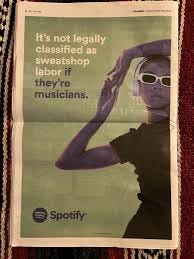
And all the while, Spotify continues to pay artists a laughable $0.004 per stream, 40% of a penny. The average independent artist makes $3 per thousand listens, exactly enough to ride the L train with us angry Brooklynites one time4. The youngsters working at the Gildan factory in Guangdong, China, make more than your musician friend does on Spotify. This is a model working exactly as designed.
Music critic Ted Gioia has well-documented what happens downstream. Old songs now account for the majority of streaming activity. In 2024, UMG, with their $12.8 billion in annual revenue, announced $270 million in cost cuts over three years through headcount reduction while simultaneously increasing catalog acquisition spending by ~50% year-over-year5. They’re buying proven old music while cutting the people who develop new artists.

Journalist Liz Pelly unearthed Spotify’s internal “Perfect Fit Content” program in her book, Mood Machine: The Rise of Spotify and the Costs of the Perfect Playlist. PFC is a deliberate initiative to populate curated playlists with cheap, commissioned music under fake artist names, to replace streams from real musicians with streams that paid lower rates6. By 2017, it was one of Spotify’s biggest profitability schemes.
The people who control what you hear are putting cheaper music inside your playlists to cut their own costs. We’re approaching PFC’s 10th birthday.
Now, enter AI. An estimated 75,000 fully AI-generated songs hit streaming platforms every day, a number that is currently seeing hockey-stick growth. 44% of all song uploads on Deezer are AI, with an estimated 85% of streams on those tracks deemed fraudulent7. An endgame that’s already partially operational is one where AI continues to generate ever more amounts of music for bots to stream, running up numbers on songs that never touch a human ear, the earnings flowing to holding companies.
The dead internet theory finds its hollow sound.
The labels know what this means for their once-tightly-held position of power in the music industry. Universal sued AI music generator Udio for copyright infringement, then became their business partner the following year8. Another slightly less poisonous result may be a catalog of 50 years of recorded music, licensed for AI training, generating output in seconds, on demand, without any living artist involved. Would you listen to robot Prince?
I’ve spent my 20s as a node inside the financial nervous systems of some of the largest publicly traded companies in the world, translating enterprise performance into language that moved dollars around.
Telling the right story using the numbers.
From this vantage point I never really saw the music industry as the creative enterprise it claims to be, but instead an IP holding structure where songs are being managed for return rather than meaning.
But the thing the whole operation depends on—the thing PE is fervently buying, that Spotify is optimizing around, the thing AI will eventually sink—is the frozen song. And I keep thinking, now more than ever before, that the frozen song was always a lie.
A song is a relationship between sound and the moment you’re inside when you hear it. The record you loved at 16 sounds different at 28 and again at 45 because you are different and the world is different.
Music has always been a live negotiation between you and all that’s around you. It has never not been this, and it’s why concerts are so uniquely great.
The recording format proclaimed, here is the song. What it really gave you, your entire life, has been just one moment of the song, pressed into physical or digital format, severed from everything that made it feel true…
The kneejerk response to AI slop has been curation. Humans as filters, those with a keen ear controlling the tap of triple-filtered music for parched ears. But that's a rearguard action that accepts the content layer is gone and tries to extract meaning from the rubble.
It’s a Band-Aid on a severed torso.
The more dangerous move is to build formats structurally incompatible with what a model trained on frozen songs can produce.
Don't curate the flood. Build on different terrain.
So I started routing the world directly into my sound.
My system is called doux, and the music you hear through it right now has not existed before and will never exist in exactly this way again.
The stems without their composer are just files, and the code without its artist is just logic. What makes this hard to own, unlike a catalog, is that the work cannot be separated from the artist that shaped it. It needs the human musician to exist.
Every single listen is a different negotiation. The version of my song a listener in Tokyo hears tonight will never be heard by the person in Brooklyn or Rio or Oslo. The song heard during monsoon season in Kerala won’t sound the same when the storm subsides. There is no master to acquire, no static file to securitize, no moment to freeze and sell. The work lives with the artist who understands it well enough to keep it alive, where it always should have.
The first version of this is live now. It will sound different tomorrow. That’s the only promise I can make.
I’m not making music about the world. I’m making music from it.
Have a listen: doux.studio